 中文
中文 
别名:P8; COM1应用:IHC
反应种属:Human
规格:50μl/100μl
| Description |
|---|
| Transcription regulator that converts stress signals into a program of gene expression that empowers cells with resistance to the stress induced by a change in their microenvironment. Thereby participates in regulation of many process namely cell-cycle, apoptosis, autophagy and DNA repair responses (PubMed:16478804, PubMed:19650074, PubMed:16300740, PubMed:19723804, PubMed:11056169, PubMed:22858377, PubMed:11940591, PubMed:18690848, PubMed:22565310, PubMed:20181828, PubMed:30451898). Controls cell cycle progression and protects cells from genotoxic stress induced by doxorubicin through the complex formation with TP53 and EP300 that binds CDKN1A promoter leading to transcriptional induction of CDKN1A (PubMed:18690848). Protects pancreatic cancer cells from stress-induced cell death by binding the RELB promoter and activating its transcription, leading to IER3 transactivation (PubMed:22565310). Negatively regulates apoptosis through interaction with PTMA (PubMed:16478804). Inhibits autophagy-induced apoptosis in cardiac cells through FOXO3 interaction, inducing cytoplasmic translocation of FOXO3 thereby preventing the FOXO3 association with the pro-autophagic BNIP3 promoter (PubMed:20181828). Inhibits cell growth and facilitates programmed cell death by apoptosis after adriamycin-induced DNA damage through transactivation of TP53 (By similarity). Regulates methamphetamine-induced apoptosis and autophagy through DDIT3-mediated endoplasmic reticulum stress pathway (By similarity). Participates to DNA repair following gamma-irradiation by facilitating DNA access of the transcription machinery through interaction with MSL1 leading to inhibition of histone H4′ Lys-16′ acetylation (H4K16ac) (PubMed:19650074). Coactivator of PAX2 transcription factor activity, both by recruiting EP300 to increase PAX2 transcription factor activity and by binding PAXIP1 to suppress PAXIP1-induced inhibition on PAX2 (PubMed:11940591). Positively regulates cell cycle progression through interaction with COPS5 inducing cytoplasmic translocation of CDKN1B leading to the CDKN1B degradation (PubMed:16300740). Coordinates, through its interaction with EP300, the assiociation of MYOD1, EP300 and DDX5 to the MYOG promoter, leading to inhibition of cell-cycle progression and myogenic differentiation promotion (PubMed:19723804). Negatively regulates beta cell proliferation via inhibition of cell-cycle regulatory genes expression through the suppression of their promoter activities (By similarity). Also required for LHB expression and ovarian maturation (By similarity). Exacerbates CNS inflammation and demyelination upon cuprizone treatment (By similarity). |
| Specification | |
|---|---|
| Aliases | P8; COM1 |
| Swissprot | O60356 |
| Host/Isotype | Rabbit IgG |
| Storage | Store at 4°C short term. Aliquot and store at -20°C long term. Avoid freeze/thaw cycles. |
| Species Reactivity | Human |
| Immunogen | Fusion protein of human NUPR1 |
| Formulation | pH7.4 PBS, 0.05% NaN3, 40% Glycerol |
| Application | |
|---|---|
| IHC | 1/100-1/300 |
| ELISA | 1/5000-1/10000 |
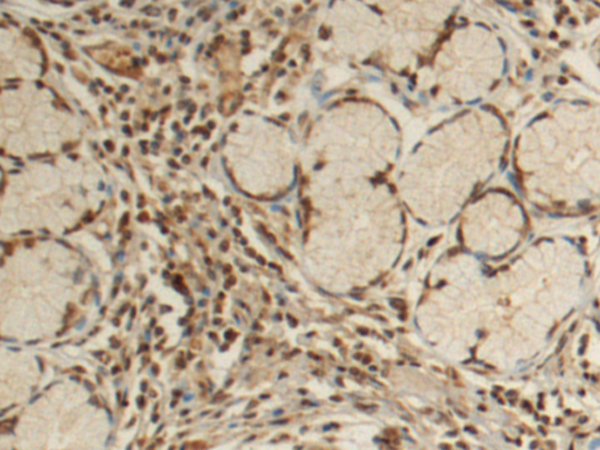 |
The image is immunohistochemistry of paraffin-embedded Human gastric cancer tissue using P08581(NUPR1 Antibody) at dilution 1/100. (Original magnification: ×200) |
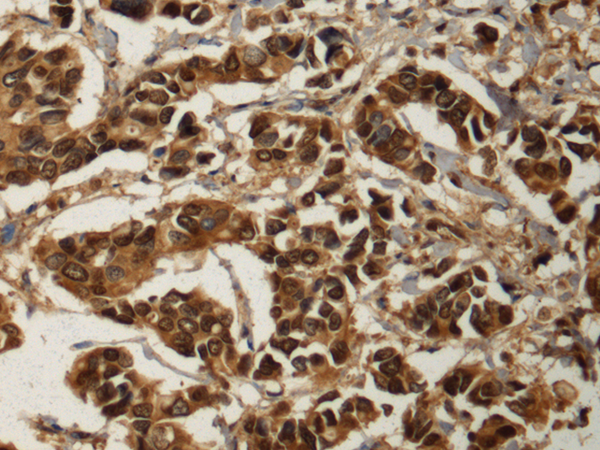 |
The image is immunohistochemistry of paraffin-embedded Human breast cancer tissue using P08581(NUPR1 Antibody) at dilution 1/100. (Original magnification: ×200) |
本公司的所有产品仅用于科学研究或者工业应用等非医疗目的,不可用于人类或动物的临床诊断或治疗,非药用,非食用。
暂无评论
本公司的所有产品仅用于科学研究或者工业应用等非医疗目的,不可用于人类或动物的临床诊断或治疗,非药用,非食用。

发表回复